SOLID STATE PRESS
← Back to catalog
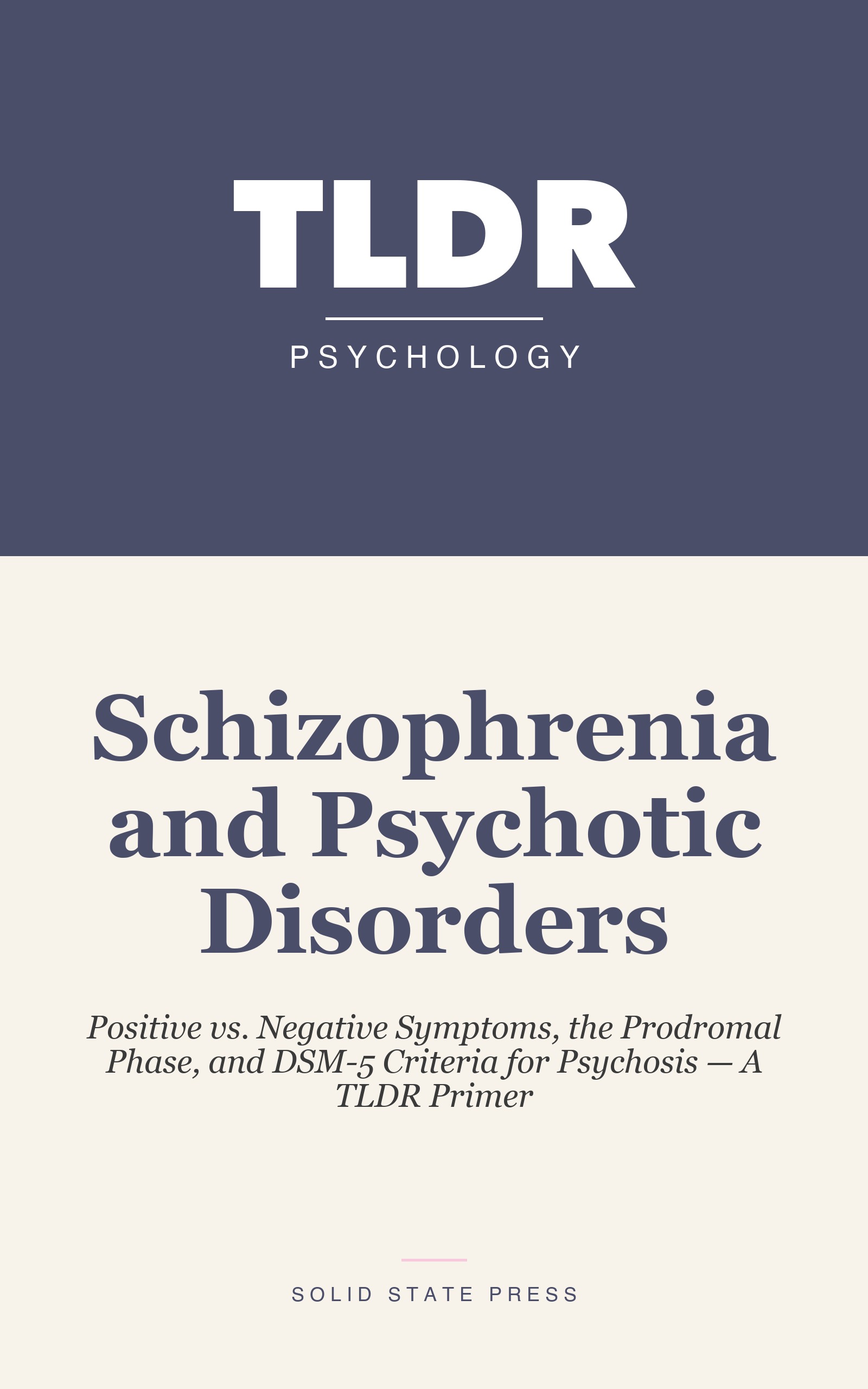
Schizophrenia and Psychotic Disorders cover
Coming soon
Coming soon to Amazon
This title is in our publishing queue.
Browse available titles
Psychology

Schizophrenia and Psychotic Disorders

Positive vs. Negative Symptoms, the Prodromal Phase, and DSM-5 Criteria for Psychosis — A TLDR Primer

You have an abnormal psychology exam coming up, a unit on mental illness in your AP Psych class, or a research paper on schizophrenia — and the textbook chapter feels overwhelming. This guide covers what you actually need.

**TLDR: Schizophrenia and Psychotic Disorders** is a focused, jargon-free primer that walks you through psychosis from the ground up. You'll learn what distinguishes a hallucination from a delusion, how the DSM-5 diagnostic criteria for schizophrenia work, and how clinicians tell schizophrenia apart from schizoaffective disorder, brief psychotic disorder, and substance-induced psychosis. The book also covers the neuroscience — the dopamine hypothesis, heritability, and the neurodevelopmental model — and explains how antipsychotic medications, CBT for psychosis, and family interventions fit together in real treatment. A final section tackles the myths students hear most (split personality, inevitable violence) and sets the record straight.

This guide is written for high school students in psychology courses, early college students taking Intro to Psychology or Abnormal Psychology, and parents or tutors who want a clear map of the topic before helping someone study. It is deliberately short by design: no padding, no detours, just the concepts you need to understand psychotic disorders and explain them on an exam.

If you need a reliable intro to psychology mental illness primer that gets you exam-ready without the filler, this is it.

Pick up your copy and walk into class prepared.

What you'll learn
  • Define psychosis and distinguish positive, negative, and cognitive symptoms
  • Recognize the DSM-5 criteria for schizophrenia and how it differs from related disorders
  • Explain leading biological and environmental models, including the dopamine and neurodevelopmental hypotheses
  • Describe how antipsychotic medications and psychosocial treatments work and what their limits are
  • Identify common misconceptions about schizophrenia (violence, split personality, bad parenting) and correct them
What's inside
  1. 1. What Psychosis Actually Is
    Defines psychosis as a break from shared reality and introduces the core symptom categories that show up across psychotic disorders.
  2. 2. Schizophrenia: Diagnosis and Course
    Walks through the DSM-5 criteria for schizophrenia, the typical age of onset, the prodromal-active-residual phases, and how clinicians rule out look-alike conditions.
  3. 3. The Spectrum: Related Psychotic Disorders
    Distinguishes schizophrenia from schizoaffective disorder, schizophreniform disorder, brief psychotic disorder, delusional disorder, and substance-induced psychosis, plus the psychotic features that can appear in mood disorders.
  4. 4. Causes: Genes, Brain, and Environment
    Surveys what's known about the biology and risk factors for schizophrenia, from heritability and the dopamine hypothesis to prenatal stressors, cannabis use, and the neurodevelopmental model.
  5. 5. Treatment: Medication and Beyond
    Explains how typical and atypical antipsychotics work, why side effects matter for adherence, and how CBT for psychosis, family interventions, and supported employment fit in.
  6. 6. Stigma, Myths, and Why This Matters
    Corrects common misconceptions (split personality, inevitable violence, bad parenting), summarizes prognosis, and points to where research and policy are heading.
Published by Solid State Press
Schizophrenia and Psychotic Disorders cover
TLDR STUDY GUIDES

Schizophrenia and Psychotic Disorders

Positive vs. Negative Symptoms, the Prodromal Phase, and DSM-5 Criteria for Psychosis — A TLDR Primer
Solid State Press

Contents

  1. 1 What Psychosis Actually Is
  2. 2 Schizophrenia: Diagnosis and Course
  3. 3 The Spectrum: Related Psychotic Disorders
  4. 4 Causes: Genes, Brain, and Environment
  5. 5 Treatment: Medication and Beyond
  6. 6 Stigma, Myths, and Why This Matters
Chapter 1

What Psychosis Actually Is

Imagine your brain has a filter. It takes in raw sensory data and cross-checks it against everything you know about shared reality — what's actually out there, what other people can confirm, what's physically possible. Most of the time that filter runs silently. Psychosis is what happens when it breaks down. A person experiencing psychosis loses reliable contact with shared reality: they may perceive things that aren't there, hold beliefs that can't be corrected by evidence, or think and speak in ways that no longer follow coherent logic.

Psychosis is not a diagnosis on its own — it's a state that shows up in several different disorders. Schizophrenia is the one most people think of, but the same core features appear in schizoaffective disorder, brief psychotic disorder, and even in severe episodes of bipolar disorder or major depression. Understanding the symptom categories first gives you a toolkit you can apply across all of them.

Positive Symptoms: Something Added

The word positive here does not mean "good." In clinical language, positive symptoms are experiences or behaviors that have been added to a person's mental life — things that healthy people don't have. There are three main types.

Delusions are fixed, false beliefs that persist despite clear contradictory evidence and that fall outside the person's cultural or religious norms. The key word is fixed: you can show someone proof that their belief is wrong, and they won't update it. Common themes include persecution (believing others are plotting against you), grandiosity (believing you have extraordinary powers or a special mission), reference (believing that random events — a news broadcast, a stranger's cough — are sending you personal messages), and thought insertion or control (believing your thoughts are being placed in your mind by an outside force).

Hallucinations are perceptions that occur without any external stimulus. You experience something — hear it, see it, smell it — but there's no physical source. The most common type in psychotic disorders is auditory: hearing voices that comment on your behavior, argue with each other, or issue commands. Visual hallucinations occur but are more characteristic of certain medical or substance-related causes, which is why clinicians pay attention when vision is the primary modality.

About This Book

If you're staring down a unit on abnormal psychology and need a clear, exam-ready schizophrenia study guide for students who don't have time to wade through a textbook, this is for you. It fits high school psychology courses, AP Psychology, and anyone in Psych 101 who just hit the mental disorders module and needs things to click fast.

This book covers everything in a typical abnormal psychology exam review: what psychosis actually is, how schizophrenia is diagnosed using DSM-5 criteria, how clinicians distinguish it from related conditions like schizoaffective disorder and brief psychotic disorder, and what current research says about causes and treatment. Along the way it explains the vocabulary that trips students up — positive and negative symptoms, hallucinations, delusions, dopamine dysregulation — making it a practical intro to psychology mental illness primer in about 15 focused pages.

Read it straight through once. The worked examples and review questions at the end will tell you quickly what you've locked in and what still needs work.

Keep reading

You've read the first half of Chapter 1. The complete book covers 6 chapters in roughly fifteen pages — readable in one sitting.

Coming soon to Amazon