SOLID STATE PRESS
← Back to catalog
Richard Feynman: Genius of QED cover
Coming soon
Coming soon to Amazon
This title is in our publishing queue.
Browse available titles
Famous Scientists

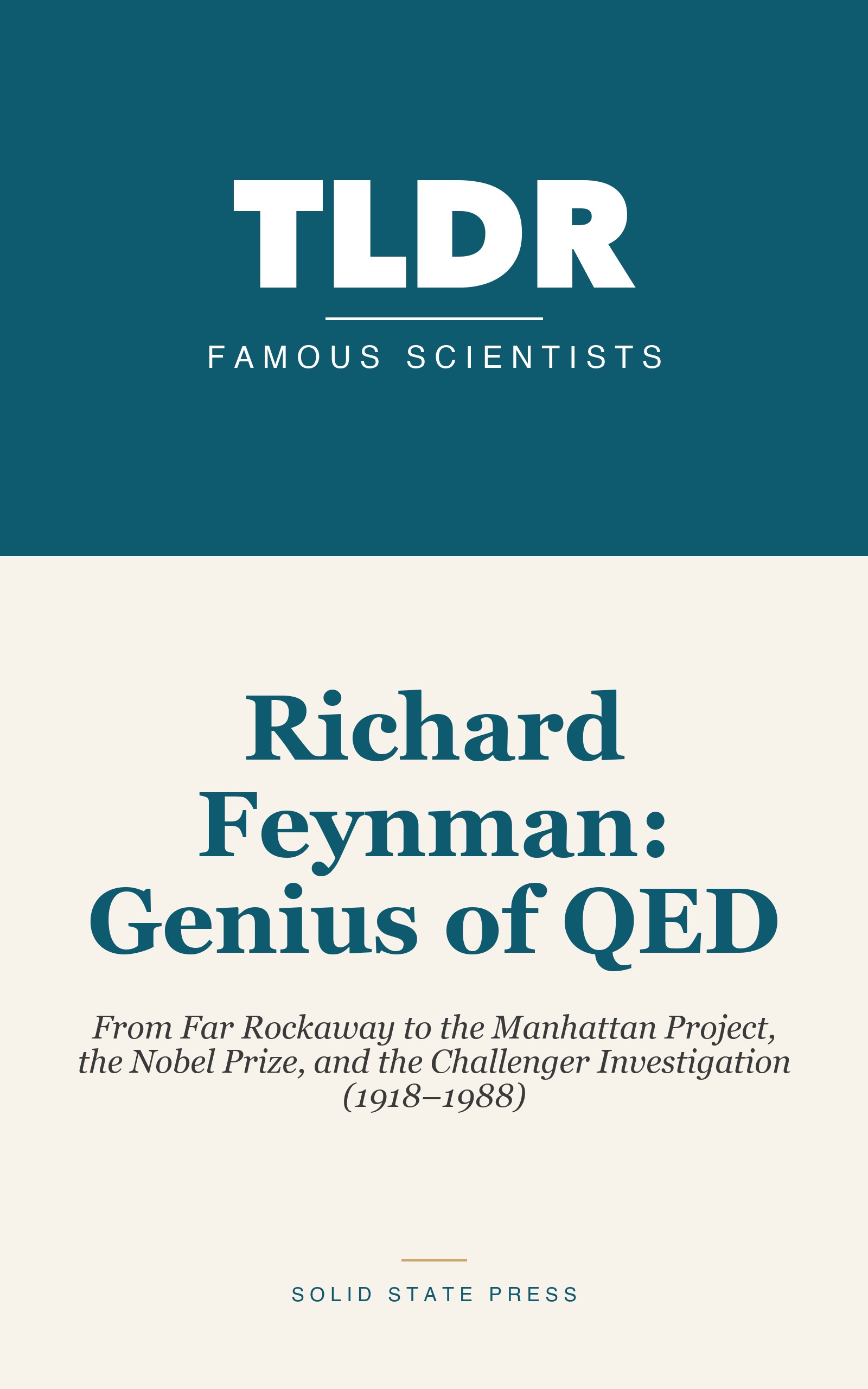
Richard Feynman: Genius of QED

From Far Rockaway to the Manhattan Project, the Nobel Prize, and the Challenger Investigation (1918–1988)

Your physics teacher mentions Feynman. Your textbook has a diagram named after him. You nod — but you're not sure who he actually was or why anyone keeps talking about him. This guide fixes that, concise by design.

**TLDR: Richard Feynman** covers the full arc of one of the twentieth century's most consequential scientists: a self-taught kid from Queens who cracked safes at Los Alamos, helped build the atomic bomb, then rebuilt quantum electrodynamics from scratch and won the Nobel Prize. You'll get a clear explanation of what Feynman diagrams actually show, why path integrals were a radical idea, and how a physicist ended up on national television dunking O-rings in ice water after the Challenger explosion.

This is a short, direct biography for high school students and early college readers who want the real story — not a hagiography, not a textbook chapter. Each section pairs the life narrative with just enough physics context to make the science make sense. If you've been searching for a quantum physics explained for high school resource that doesn't drown you in equations, this is it.

It also covers the parts other summaries skip: Feynman's first wife Arline dying of tuberculosis while he worked on the bomb, the genuine moral reckoning of Trinity, his complicated legacy as a teacher, and recent historical reappraisals of the man behind the myth.

No filler, built for a study session, a class prep, or a curious afternoon. Pick it up and get oriented.

What you'll learn
  • Understand what shaped Feynman as a thinker and what he's best known for in physics.
  • Trace the major events of his scientific career, from Los Alamos to Caltech.
  • Grasp the core ideas behind path integrals, QED, and Feynman diagrams at a conceptual level.
  • Weigh the historical assessment of Feynman's legacy as a physicist, teacher, and public figure.
What's inside
  1. 1. Far Rockaway: A Mind in the Making
    Feynman's childhood in Queens, his father's influence, and the early habits of curiosity and self-teaching that defined him.
  2. 2. Los Alamos and the Bomb
    Feynman's work on the Manhattan Project, his role under Hans Bethe, the death of his first wife Arline, and the moral weight of Trinity.
  3. 3. QED and the Nobel Prize
    Feynman's reinvention of quantum electrodynamics at Cornell and Caltech, path integrals, Feynman diagrams, and the 1965 Nobel.
  4. 4. The Great Explainer
    Feynman at Caltech as teacher and public figure: the Feynman Lectures, weak interactions, partons, nanotechnology, and his second and third marriages.
  5. 5. Challenger and the Final Years
    Feynman's role on the Rogers Commission investigating the 1986 Challenger disaster, his battle with cancer, and his death in 1988.
  6. 6. Legacy: Physicist, Teacher, Icon
    How physicists and historians assess Feynman today — his lasting contributions, the cult of personality around him, and recent reappraisals.
Published by Solid State Press
Richard Feynman: Genius of QED cover
TLDR STUDY GUIDES

Richard Feynman: Genius of QED

From Far Rockaway to the Manhattan Project, the Nobel Prize, and the Challenger Investigation (1918–1988)
Solid State Press

Contents

  1. 1 Far Rockaway: A Mind in the Making
  2. 2 Los Alamos and the Bomb
  3. 3 QED and the Nobel Prize
  4. 4 The Great Explainer
  5. 5 Challenger and the Final Years
  6. 6 Legacy: Physicist, Teacher, Icon
Chapter 1

Far Rockaway: A Mind in the Making

Richard Feynman was born on May 11, 1918, in Manhattan and grew up in the Far Rockaway neighborhood of Queens, New York — a middle-class seaside community on the Atlantic shore of Long Island, far enough from Manhattan to feel like its own world. It was exactly the kind of place where a curious kid could take things apart and no one would much mind.

Melville Feynman, Richard's father, was a salesman who sold uniforms and had no formal scientific training. What he had instead was a philosophy: knowing the name of something is not the same as knowing the thing itself. Melville acted on this constantly. When Richard was still a toddler, Melville would set out rows of different-colored tiles and arrange them in patterns — introducing ratio and sequence before his son could read. On walks through the woods, Melville would point to a bird and say, "That's a brown-throated thrush — in Portuguese it's called this, in Chinese it's called that. Now you know all the names for it. But you still know nothing about the bird." That lesson — the difference between labeling and understanding — stayed with Feynman for life. You can hear it in every lecture he ever gave.

His mother, Lucille, contributed something different: humor and a refusal to be overly serious. Feynman would later say she was the source of whatever comedic sensibility he had. The household was Jewish but not strictly observant, and the culture was one of argument, stories, and relentless "why?"

By the time Feynman was in grade school, he had built himself a home laboratory in his bedroom. He wired his room with a homemade burglar alarm and began repairing neighbors' radios for spare change during the Great Depression. This was not hobbyist tinkering — he was diagnosing circuits, forming hypotheses, testing them. A neighbor would bring a broken radio, and Feynman would walk back and forth thinking before he touched it, a habit that apparently unnerved people expecting more physical activity. He was reasoning through the problem first.

About This Book

If you're looking for a Richard Feynman biography for students — whether you're prepping for an AP Physics course, writing a paper on twentieth-century science, or just curious about one of the most original minds in modern history — this book is for you. Parents helping a middle or high schooler with a science fair project and tutors running a quick session on quantum mechanics will find it equally useful.

This Feynman life story study guide covers his childhood in Queens, his work as a Manhattan Project scientist, and how he built quantum electrodynamics (QED) into a Nobel Prize-winning theory. It makes quantum physics explained for high school readers feel genuinely possible, traces his legendary teaching career, and walks through the Challenger disaster investigation that made him a household name. A concise overview with no filler.

Read straight through for the narrative, then use the review questions at the end to lock in what you've learned.

Keep reading

You've read the first half of Chapter 1. The complete book covers 6 chapters in roughly fifteen pages — readable in one sitting.

Coming soon to Amazon