SOLID STATE PRESS
← Back to catalog
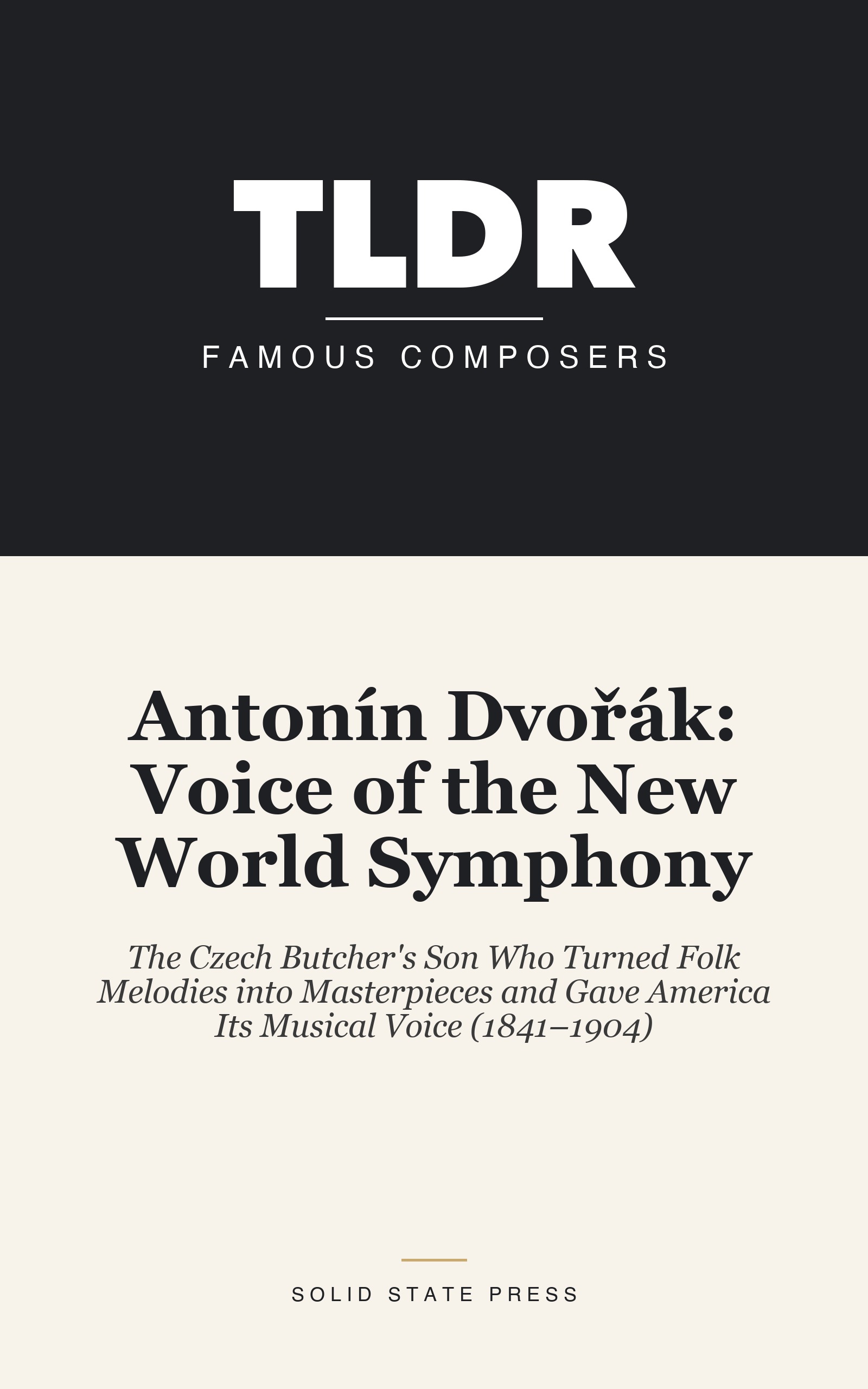
Antonín Dvořák: Voice of the New World Symphony cover
Coming soon
Coming soon to Amazon
This title is in our publishing queue.
Browse available titles
Famous Composers

Antonín Dvořák: Voice of the New World Symphony

The Czech Butcher's Son Who Turned Folk Melodies into Masterpieces and Gave America Its Musical Voice (1841–1904)

Got a music history paper due, a theory class covering the Romantic era, or a curiosity about how a butcher's son from Bohemia ended up shaping American classical music? This biography cuts straight to what matters.

**TLDR: Antonín Dvořák** covers the full arc of his life with no filler — from his scrappy childhood in rural Bohemia and his years as a near-broke violist in Prague, to the friendship with Johannes Brahms that made him famous across Europe, to his landmark three years directing the National Conservatory in New York. Along the way you'll understand why the New World Symphony still fills concert halls, what Dvořák actually said about Black and Native American music (and why historians still argue about it), and how one composer helped define what "national music" could mean.

This is a Dvořák biography for students who need the real story fast — not a textbook chapter padded with trivia, and not a dry catalogue of opus numbers. Each section leads with the single most important thing to know, then unpacks it with specific dates, places, and named events. Common myths get corrected inline.

Ideal for high school and early college students, music appreciation courses, AP Music Theory context reading, or anyone wanting a concise romantic era composer overview before a class or exam.

Pick it up, read it in one sitting, and walk in ready.

What you'll learn
  • Understand what shaped Dvořák as a composer and what he is best known for.
  • Trace the major events of his life from rural Bohemia to New York and back.
  • Weigh the historical assessment of his music and his ideas about national style.
What's inside
  1. 1. A Butcher's Son in Bohemia
    Dvořák's childhood, musical training, and early years scraping by as a violist in Prague.
  2. 2. Breakthrough and the Brahms Connection
    Marriage, the Austrian State Stipendium, and how Brahms's mentorship launched Dvořák into European fame.
  3. 3. A Czech Voice in European Concert Halls
    The mature 1880s: symphonies, operas, and Dvořák's role in defining a Czech national style.
  4. 4. America and the New World Symphony
    Dvořák's three years directing the National Conservatory in New York and his famous engagement with Black and Native American music.
  5. 5. Final Years in Prague
    Return to Bohemia, late operas, his death in 1904, and the family and students he left behind.
  6. 6. Legacy and the Argument Over National Music
    How Dvořák is judged today, the ongoing debate about his American advice, and his place in the symphonic repertoire.
Published by Solid State Press
Antonín Dvořák: Voice of the New World Symphony cover
TLDR STUDY GUIDES

Antonín Dvořák: Voice of the New World Symphony

The Czech Butcher's Son Who Turned Folk Melodies into Masterpieces and Gave America Its Musical Voice (1841–1904)
Solid State Press

Contents

  1. 1 A Butcher's Son in Bohemia
  2. 2 Breakthrough and the Brahms Connection
  3. 3 A Czech Voice in European Concert Halls
  4. 4 America and the New World Symphony
  5. 5 Final Years in Prague
  6. 6 Legacy and the Argument Over National Music
Chapter 1

A Butcher's Son in Bohemia

On September 8, 1841, Antonín Leopold Dvořák was born in Nelahozeves, a small village on the Vltava River about twenty miles north of Prague. His father, František Dvořák, ran the local inn and butcher shop — a respectable but modest living. The family was musical in the way many Central European village families were: František played the zither at local celebrations, and Antonín absorbed folk melodies and dance rhythms from the time he could sit still and listen. That early saturation in Czech folk sound never left him.

Bohemia at the time was not an independent country. It was a province of the Austrian Habsburg Empire, governed from Vienna, with German as the prestige language of administration, education, and high culture. Czech was the language of peasants and tradespeople — people like the Dvořáks. Growing up Czech in mid-nineteenth-century Bohemia meant growing up on the cultural margin. That position shaped a generation of artists who were fiercely invested in asserting Czech identity through music, literature, and language. Dvořák would become one of the most prominent of them, though that was still decades away.

His first formal music teacher was Antonín Liehmann, the organist and schoolmaster in the nearby town of Zlonice, where Frantisek moved the family when Antonín was around twelve. Liehmann was a capable musician who recognized the boy's talent and pushed him beyond the basics — violin, viola, piano, organ, and the rudiments of music theory. Czech village schoolmasters of this era often doubled as church musicians, so Liehmann's instruction was practical and broad. Dvořák absorbed it quickly.

The question of a serious musical education came to a head when Dvořák was sixteen. His father could not fund a long career of study, and the expectation was that Antonín would learn the butcher trade. A compromise was struck: he would go to Prague, but to learn German at his uncle's expense — German being the key to economic advancement in Habsburg Bohemia. Once in Prague, Dvořák redirected the opportunity. In 1857, at age sixteen, he enrolled in the Prague Organ School, a two-year conservatory-level institution that trained church musicians and gave rigorous grounding in harmony, counterpoint, and composition.

A common assumption is that Dvořák arrived in Prague as a polished prodigy. The reality is more ordinary: he was a talented provincial student, strong enough to stand out but working hard to catch up on theory he had not been systematically taught. He graduated in 1859, ranked second in his class — good, not legendary.

About This Book

If you need a Dvořák biography for students — whether you're writing a paper for AP Music Theory, preparing a presentation on Romantic era composers, or just trying to decode a program note before a concert — this is the book. It also works for parents and tutors who want a fast, reliable reference without wading through a 400-page academic text.

This Czech composer study guide for high school covers everything from Dvořák's village childhood to Brahms's patronage, his years in New York, and the New World Symphony explained for beginners in plain, precise language. Along the way you'll pick up the core vocabulary of music history — nationalism, folk melody, symphonic form — making it a useful Dvořák and American folk music primer and a broader classical music composer life story for teens who are just getting oriented in the Romantic era. A concise overview with no filler.

Read it straight through. This music history biography short book is built for a single focused sitting, so give it one.

Keep reading

You've read the first half of Chapter 1. The complete book covers 6 chapters in roughly fifteen pages — readable in one sitting.

Coming soon to Amazon